

Step 2 — AI analysis

Imagine if your heart treatment came with a scoreboard.

Not vague reassurance. Not "your cholesterol looks better, so I think your heart is better." A real scoreboard that shows, in black and white, whether the dangerous plaque in your arteries is going up or down.

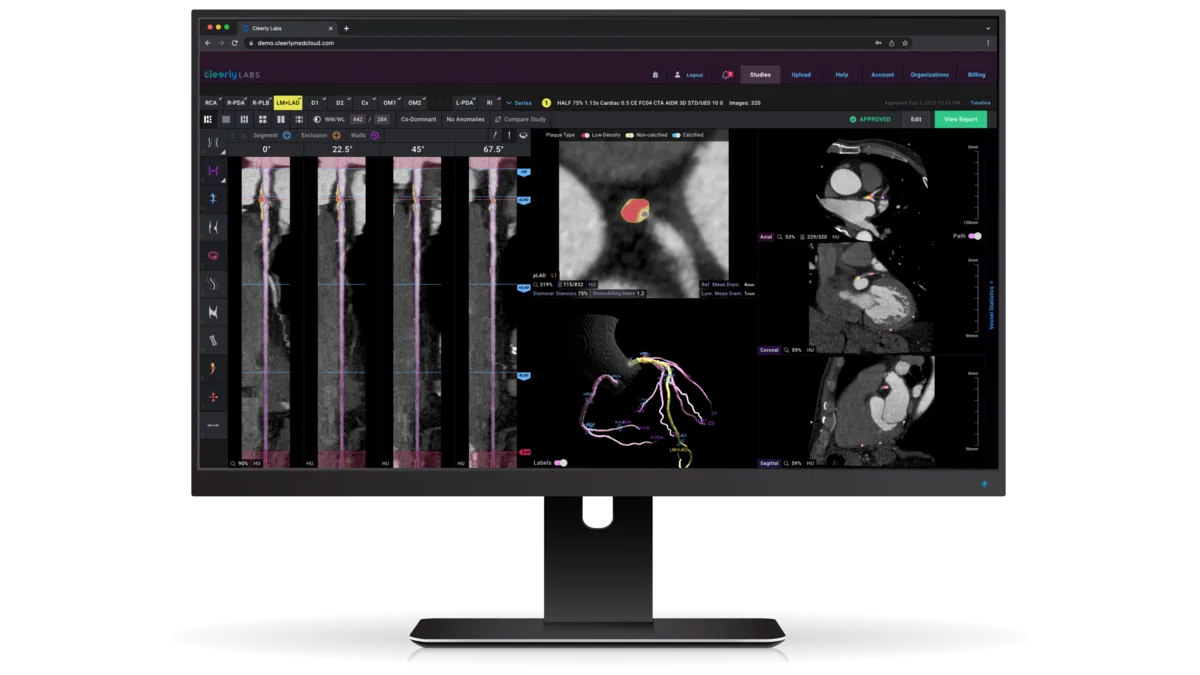
Cleerly Labs report showing AI-quantified coronary plaque on a ClearCardio patient scan

What you're looking at

At the top you see two columns: Compared — your earlier scan — and Current — your latest scan. Each row is something the AI has measured inside your coronary arteries.

  • Total Plaque Volume — how much plaque exists in all your heart arteries, in cubic millimetres
  • Total Non-Calcified Plaque — the softer, waxy plaque that is easier to melt away but also easier to rupture
  • Low-Density Non-Calcified Plaque — the most dangerous, lava-like plaque that causes sudden heart attacks
  • Total Calcified Plaque — the hard, scarred plaque that is more stable and less likely to burst
  • Stenosis — how many spots are moderately or severely narrowed
  • Remodeling Index & Stenosis % — how much the artery wall has bulged outward and how tight the worst narrowing is

Green arrows mean a number has gone down. Orange arrows mean it has gone up.

Why this is revolutionary

In traditional cardiology, doctors looked at cholesterol, blood pressure and maybe a stress test, and guessed whether things were improving. Here, we don't guess.

We can say: "Last year you had 963.9 mm³ of soft plaque. Now you have 861.8. You've removed over 100 mm³ of the stuff that actually ruptures." We can point at the low-density line and say: "That especially high-risk plaque has dropped from 7.4 to 2.1. That's exactly what we were aiming for."

If something isn't working, we see that too — total plaque rising, new moderate narrowings appearing, soft plaque not shrinking. We don't wait for a heart attack to tell us the plan failed. We change the plan now.

Why this matters to you

1. It measures your real disease

  • Not just blockages, but the full amount and types of plaque in every major artery

2. It turns treatment into an experiment we can score

  • Medications, lifestyle, supplements: we see which ones actually move your numbers

3. It lets you watch your progress over time

  • Each scan becomes a chapter: here's how much dangerous plaque you had, and here's how much we've taken away
It's not about pretty graphics. It's about finally having proof instead of hope that your treatment is reversing the disease that causes heart attacks.

For the first time, you and your doctor can sit side by side, look at your arteries on screen and say with confidence: "This is working. Keep going." Or, if needed: "This isn't enough yet. Let's change it."

Book a call

Stop guessing. Get real answers about your heart.

One visit in person. Ongoing prevention by telehealth.

Wherever you live, you can apply to join ClearCardio's patent-pending prevention program. You'll start with a single on-site visit at one of our clinics, then continue your care through structured telehealth visits, virtual coaching and remote monitoring designed to track and treat plaque over time.

With 30 years of preventative cardiology, 25,000 evaluations over 21 years and a proven process, you're in excellent hands. On your Patient Assessment Call we'll review your history and goals, explain how travel and telehealth would work for you, and make sure the program is a good fit before you commit.

  • Secure, HIPAA-compliant telehealth platform
  • No obligation — your first step is an assessment, not a contract
  • Evaluated by Dr. Osborne's specialized Patient Assessment Team

Book a Patient Assessment

We'll never share your information. Submitting this is not a medical diagnosis.

+1 (855) 207-5554